

Professional Gutter Installation Across Chicago's Southwest and Western Suburbs
A gutter system that works is one that was designed and installed with the property's specific drainage needs in mind.
Seamless vs. Sectional Gutters: Why Seamless Wins
Sectional gutters have one inherent structural weakness: every joint is a potential leak point. Over time, thermal expansion and contraction from Chicago's freeze-thaw cycles work those joints loose. Sealant degrades. Fasteners back out.
Seamless gutters are roll-formed on-site from a single continuous run of aluminum stock, custom-cut to the exact length of each gutter run. There are no field joints along the horizontal run. We operate a portable gutter machine that produces seamless runs on-site. The practical cost difference between seamless and sectional is minimal. The performance difference over a 10-to-20-year horizon is significant.
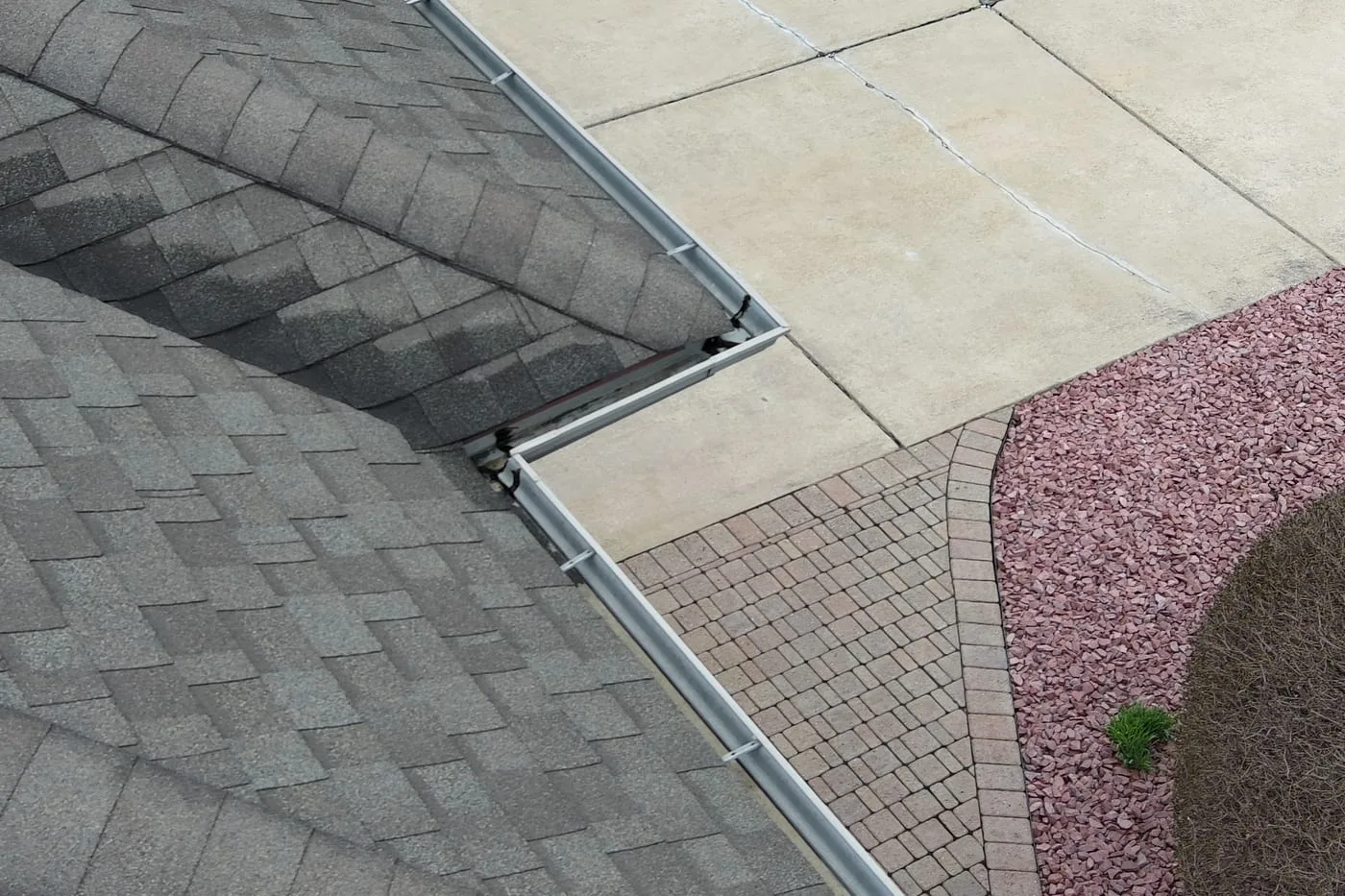
Sizing and Profile Selection
The two dominant residential profiles are 5-inch K-style and 6-inch K-style, with half-round gutters used primarily on historical properties. A 5-inch K-style gutter holds approximately 1.2 gallons per linear foot. A 6-inch K-style holds approximately 2.0 gallons per linear foot, a 67% capacity increase.
- K-style gutters have a flat back wall and a decorative ogee profile on the front face. Efficient, widely compatible with standard fascia configurations, and the correct choice for the majority of residential applications.
- Half-round gutters offer a curved, open profile suitable for older or architecturally detailed homes where character takes priority.
We specify size based on actual load calculations, not assumptions.
Slope, Pitch, and Why Standing Water Is a System Failure
Gutters must be installed with a controlled downward slope toward the downspout, typically 1/4 inch of drop per 10 linear feet of run. Without proper slope, water pools in low spots. Too steep a slope creates velocity that causes water to shoot past the downspout inlet.
On long gutter runs exceeding 40 feet, we typically install a downspout at each end and slope from the center outward. We set slope with a chalk line and level during installation, not by eye.
Downspout Placement, Quantity, and Sizing
Industry guidelines recommend one downspout per 20 to 30 linear feet of gutter run. Each downspout must be adequately sized (2x3-inch or 3x4-inch rectangular, or 3-inch round as a minimum) and positioned where discharge water can be directed away from the structure. We plan outlet locations before installation begins and discuss discharge options with the property owner.
Fascia Attachment and Material Standards
Gutters are attached to the fascia board using hidden hangers on 24-inch centers or closer. Spike-and-ferrule systems are a known failure mode that pulls out progressively. Hidden hangers grip the back wall of the gutter and screw directly into the fascia and rafter tail, distributing load correctly.
We use .032-gauge aluminum as our standard material. Aluminum does not rust, holds paint well, and performs predictably through decades of Midwest weather cycles. We do not install galvanized steel or vinyl systems.
Frequently Asked Questions
The correct gutter size depends on the square footage of the roof area draining into each run, the roof pitch, and local rainfall intensity. For most single-family homes with standard-pitch roofs, 5-inch K-style gutters are adequate for smaller drainage areas. Six-inch K-style gutters are the right choice for larger roof planes, steep pitches (8:12 and above), or any run that collects water from a significant portion of the roofline. We calculate these numbers for each project.
Properly installed, seamless aluminum gutters typically last 20 to 30 years with routine maintenance. The most common causes of early failure are installation errors rather than material degradation. Aluminum does not rust, and the natural oxide layer provides ongoing protection against corrosion.
K-style gutters have a flat back wall and a decorative front profile that resembles crown molding. They hold more water than half-round profiles of the same nominal width, making them the standard choice for most residential applications. Half-round gutters have a curved, open profile and are typically used on older or historic homes.
Not automatically. If the existing gutter system is in good condition, it can remain in place or be reinstalled after roofing work is complete. If the fascia boards are being replaced, gutters will need to be removed and reinstalled. We assess the condition of the existing gutter system as part of every roofing project estimate and give a direct recommendation.
Yes. We install gutters on structures with no existing system, including additions, detached garages, outbuildings, and commercial structures. The condition of the fascia board and the geometry of the roofline determine the installation approach.